Chapter 19
Land Allotment for Simeon
19:1 The second lot came out for Simeon, for the tribe of the people of Simeon, according to their clans, and their inheritance was in the midst of the inheritance of the people of Judah.
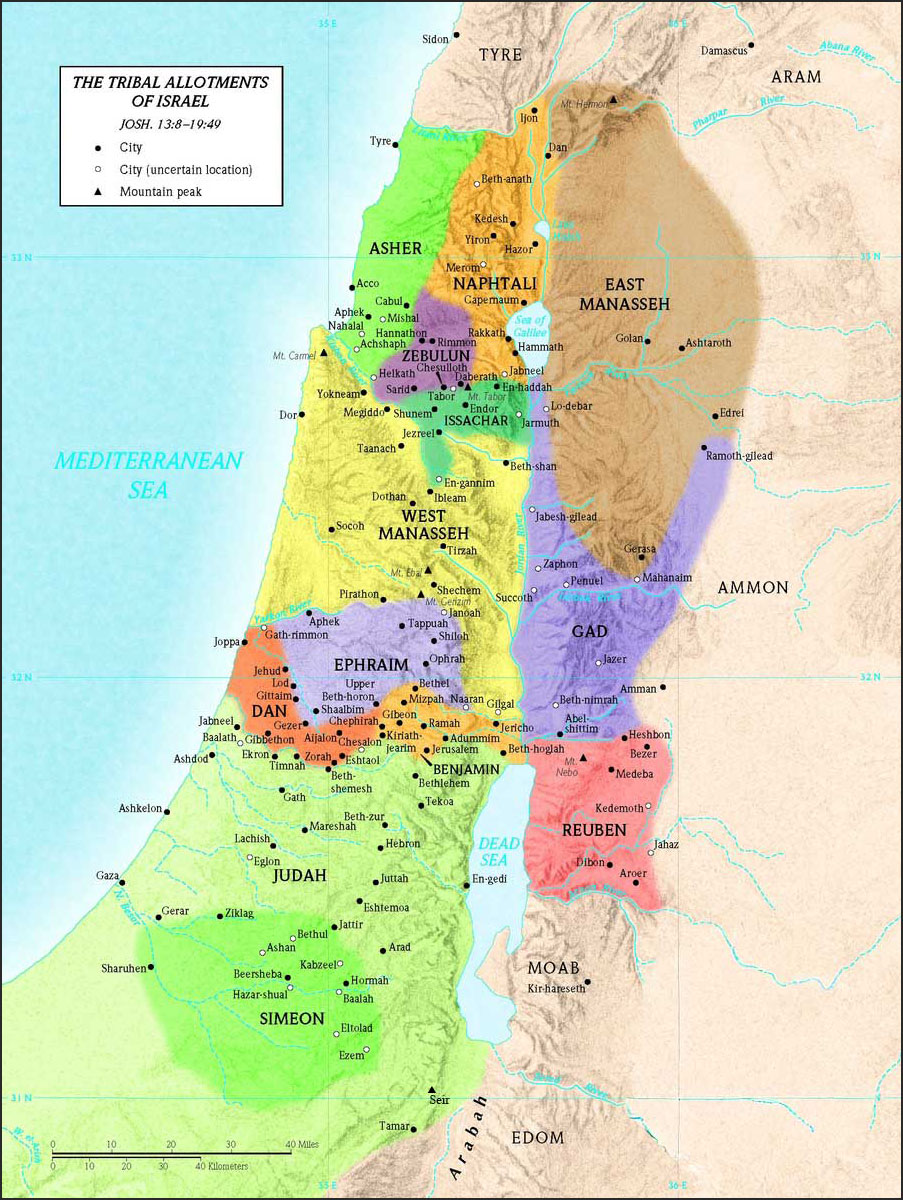
The second lot went to the tribe of Simeon, their territory would be different from all of the other allocations as it would be completely surrounded by one tribe, the people of Judah.
19:2 And they had for their inheritance Beersheba, Sheba, Moladah, 3 Hazar-shual, Balah, Ezem, 4 Eltolad, Bethul, Hormah, 5 Ziklag, Beth-marcaboth, Hazar-susah, 6 Beth-lebaoth, and Sharuhen—thirteen cities with their villages; 7 Ain, Rimmon, Ether, and Ashan—four cities with their villages, 8 together with all the villages around these cities as far as Baalath-beer, Ramah of the Negeb. This was the inheritance of the tribe of the people of Simeon according to their clans. 9 The inheritance of the people of Simeon formed part of the territory of the people of Judah. Because the portion of the people of Judah was too large for them, the people of Simeon obtained an inheritance in the midst of their inheritance.
This inheritance came out of the land that was already allocated to the tribe of Judah (sometimes called the ‘doughnut hole’ of Judah). The reason given is that the territory given to Judah was too large for them. Many believe that since God directs the lots and that He would not change His mind, that this account must be inaccurate. But when we look back at the last words of the prophecy given by Jacob at his deathbed to Simeon and Levi, that due to their violence in Shechem (see Genesis 34:25-26), “I will scatter them among the descendants of Jacob; I will disperse them throughout Israel.” (Genesis 49:7b, NLT). Here we see that prophecy being fulfilled, the tribe of Simeon being scattered in the tribe of Judah, and Levi, even though not given a land inheritance, they were given cities in all of the other territories (see Joshua 21:1-42), truly being dispersed throughout Israel.
Land Allotment for Zebulun
19:10 The third lot came up for the people of Zebulun, according to their clans. And the territory of their inheritance reached as far as Sarid. 11 Then their boundary goes up westward and on to Mareal and touches Dabbesheth, then the brook that is east of Jokneam. 12 From Sarid it goes in the other direction eastward toward the sunrise to the boundary of Chisloth-tabor. From there it goes to Daberath, then up to Japhia. 13 From there it passes along on the east toward the sunrise to Gath-hepher, to Eth-kazin, and going on to Rimmon it bends toward Neah, 14 then on the north the boundary turns about to Hannathon, and it ends at the Valley of Iphtahel; 15 and Kattath, Nahalal, Shimron, Idalah, and Bethlehem—twelve cities with their villages. 16 This is the inheritance of the people of Zebulun, according to their clans—these cities with their villages.
The territory allocated to the tribe of Zebulun was surrounded by Asher to the northwest, Naphtali to the northeast, Issachar to the southeast, and Manasseh to the southwest. The location and history of the majority of these cities are largely unknown. The Bethlehem listed is not the birthplace of Jesus (Bethlehem Ephrathah was in Judah), but Zebulun was the territory where Jesus grew up in Nazareth and His first public miracle in Cana.
Land Allotment for Issachar
19:17 The fourth lot came out for Issachar, for the people of Issachar, according to their clans. 18 Their territory included Jezreel, Chesulloth, Shunem, 19 Hapharaim, Shion, Anaharath, 20 Rabbith, Kishion, Ebez, 21 Remeth, En-gannim, En-haddah, Beth-pazzez. 22 The boundary also touches Tabor, Shahazumah, and Beth-shemesh, and its boundary ends at the Jordan—sixteen cities with their villages. 23 This is the inheritance of the tribe of the people of Issachar, according to their clans—the cities with their villages.
The tribe of Issachar was next, even though Issachar was born before Zebulon, God chose to allocate Issachar’s inheritance after Zebulon. The borders of this territory are not described, only the cities are listed. We know that Zebulon’s territory was to the northwest, Naphtali to the northeast, the Jordan River to the east, and Manasseh to the west and south. The Beth-shemesh listed here is not the same one listed in Judah (see Joshua 15:10) nor the one listed below in Naphtali (see verse 38), there were at least three cities with the same or similar name.
Land Allotment or Asher
19:24 The fifth lot came out for the tribe of the people of Asher according to their clans. 25 Their territory included Helkath, Hali, Beten, Achshaph, 26 Allammelech, Amad, and Mishal. On the west it touches Carmel and Shihor-libnath, 27 then it turns eastward, it goes to Beth-dagon, and touches Zebulun and the Valley of Iphtahel northward to Beth-emek and Neiel. Then it continues in the north to Cabul, 28 Ebron, Rehob, Hammon, Kanah, as far as Sidon the Great. 29 Then the boundary turns to Ramah, reaching to the fortified city of Tyre. Then the boundary turns to Hosah, and it ends at the sea; Mahalab, Achzib, 30 Ummah, Aphek and Rehob—twenty-two cities with their villages. 31 This is the inheritance of the tribe of the people of Asher according to their clans—these cities with their villages.
The land allotment for the tribe of Asher contained the western slopes of the mountains of Galilee. On the entire western border was the Mediterranean Sea, from Manasseh in the south, extending northward beyond Tyre to Sidon, Zebulon to the southeast, and Naphtali to the east. But no tribe of Israel to the north.
This Beth-dagon is not the same location named in Joshua 15:41, there were likely many temples erected for the primary gods and goddesses, including Dagon, Molech, Baal, and Astoreth.
Land Allotment for Naphtali
19:32 The sixth lot came out for the people of Naphtali, for the people of Naphtali, according to their clans. 33 And their boundary ran from Heleph, from the oak in Zaanannim, and Adami-nekeb, and Jabneel, as far as Lakkum, and it ended at the Jordan. 34 Then the boundary turns westward to Aznoth-tabor and goes from there to Hukkok, touching Zebulun at the south and Asher on the west and Judah on the east at the Jordan. 35 The fortified cities are Ziddim, Zer, Hammath, Rakkath, Chinnereth, 36 Adamah, Ramah, Hazor, 37 Kedesh, Edrei, En-hazor, 38 Yiron, Migdal-el, Horem, Beth-anath, and Beth-shemesh—nineteen cities with their villages. 39 This is the inheritance of the tribe of the people of Naphtali according to their clans—the cities with their villages.
The borders of the allotment put Naphtali directly east of Asher, with the southwest touching the territory of Zebulon and the southeast reaching to Issachar. The east side borders the Jordan River north of the Sea of Galilee, the entire west shore of the Sea of Galilee, and a short segment of the Jordan south of the sea. There is some debate as to what verse 34 means when it states, “Judah on the east at the Jordan,” since the territory assigned to Judah is several miles south to the north end of the Dead Sea on the west side of the Jordan. Some believe it was added by mistake since the Septuagint does not include any reference to Judah, and it is not included in all versions of English Bibles (for example Judah is not found in this verse in the NIV, NLT, etc.) Several other theories have been offered, but without further information it’s all speculation. The Beth-shesh, (the house or place of apples) as pointed out above (see verse 22) is not related to the other two cities with the same name.
Land Allotment for Dan
19:40 The seventh lot came out for the tribe of the people of Dan, according to their clans. 41 And the territory of its inheritance included Zorah, Eshtaol, Ir-shemesh, 42 Shaalabbin, Aijalon, Ithlah, 43 Elon, Timnah, Ekron, 44 Eltekeh, Gibbethon, Baalath, 45 Jehud, Bene-berak, Gath-rimmon, 46 and Me-jarkon and Rakkon with the territory over against Joppa. 47 When the territory of the people of Dan was lost to them, the people of Dan went up and fought against Leshem, and after capturing it and striking it with the sword they took possession of it and settled in it, calling Leshem, Dan, after the name of Dan their ancestor. 48 This is the inheritance of the tribe of the people of Dan, according to their clans—these cities with their villages.
Dan was the last tribe to be allocated an inheritance. An odd-shaped section of land with Judah to the south, Benjamin to the east, Ephraim to the north, with a small segment of Manasseh (from Ephraim to the coast), and the Mediterranean Sea to the west. Gezer which would be near the center of their territory was allocated to Ephraim (see Joshua 16:10).
Inheritance for Joshua
19:49 When they had finished distributing the several territories of the land as inheritances, the people of Israel gave an inheritance among them to Joshua the son of Nun. 50 By command of the LORD they gave him the city that he asked, Timnath-serah in the hill country of Ephraim. And he rebuilt the city and settled in it.
Joshua was given Timnath-serah in Ephraim for an inhertance and is considered to be modern day Khirbet Tibnah an archeological site.
19:51 These are the inheritances that Eleazar the priest and Joshua the son of Nun and the heads of the fathers’ houses of the tribes of the people of Israel distributed by lot at Shiloh before the LORD, at the entrance of the tent of meeting. So they finished dividing the land.
This verse closes the allocation of land inheritances for the people of Israel that was overseen by Eleazar the high priest, Joshua, and all the head leaders of the tribes. Each distributed by lot in Shiloh before YHWH. In other words there should not be any bickering over their inheritances.
Map of Israel Tribal Land Inheritances Based on Joshua 13:8-19:49